The Little Mermaid Is Gay
Listen to this story:

“HANS CHRISTIAN ANDERSEN,” I’ve been telling people for weeks, “was bi.”
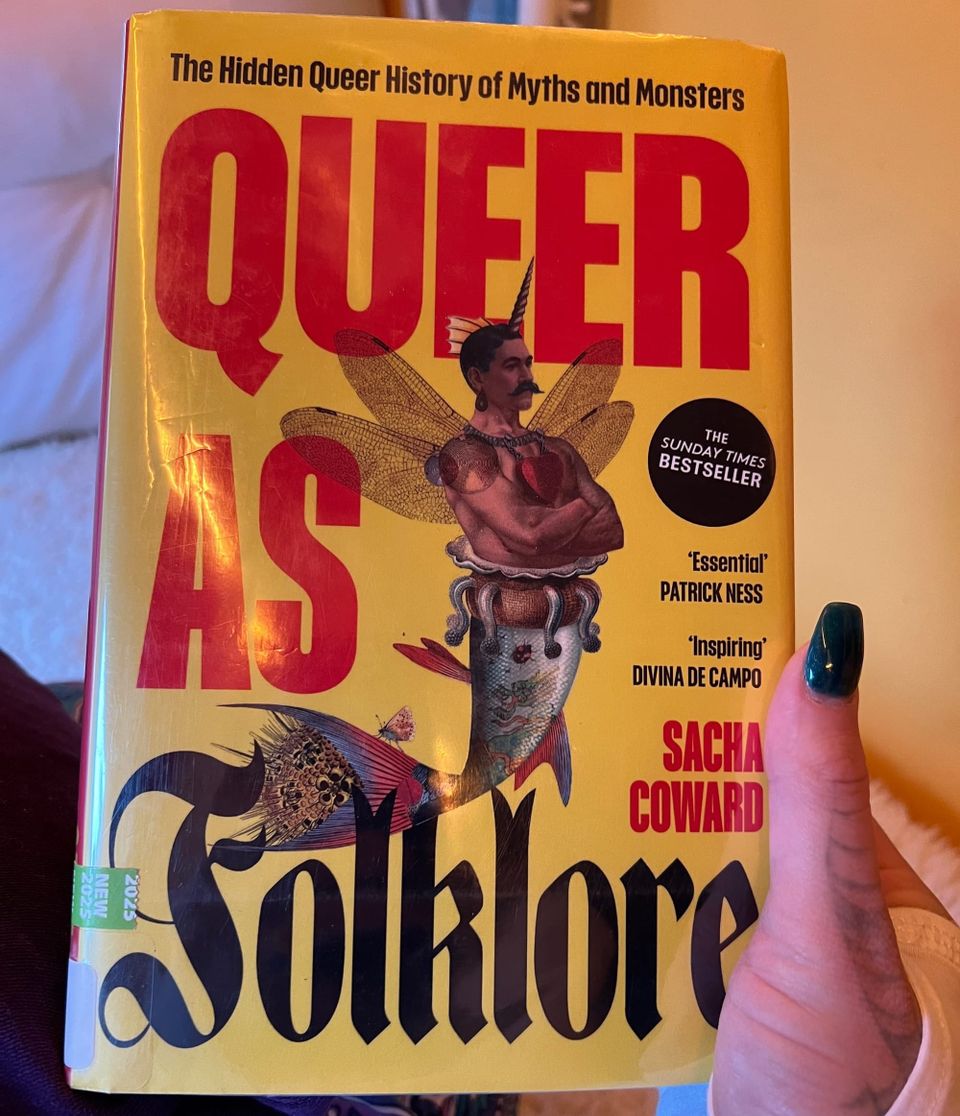
I got a book called Queer as Folklore: The Hidden Queer History of Myths and Monsters from the library. It was a staff pick—because our library staff reads very queer shit—but it wasn’t the recommendation that caught my eye. It was the super-hot fish man with the old-timey mustache on the cover.
One day, my landmate Stevie and our friend Mandy were standing in the goat pasture on this homestead, chopping apples they’d gathered for the old-timey cider press. Yes, I am aware that my environment sometimes sounds like a rural Airbnb Experience city people would purchase (just wait till the goats have babies; last week, Adam and Stevie bought a buck to impregnate them. His musk is so strong that when the wind turned the other day, I could smell it from 100 feet). I’d just read the section on The Little Mermaid, and I carried the book out to where Mandy and Stevie were chopping, at a tall, steel table, emanating the kind of good energy you get only from sharing such primal work. I sat down on an overturned barrel in the cool fall sunshine.
“Hans Christian Andersen was bi,” I told them, happy to have an audience for my news. He was wildly socially awkward, I further informed them, and equally romantically inclined, falling in love hard on the regular. He went after both men and women; both rejected him often. I read aloud a letter he’d written to an object of his gay affection, a man named Edvard.
“I long for you, yes,” Andersen wrote to him—and I read to the cidermakers—“this moment I long for you as if you were a lovely girl from Calabria, with her dark eyes and stirring glance.”
He continued:
“How often do I not think about you. How open does your soul not lie before me. I wonder if you understand me, understand my love as I have perceived you. At this moment I see you as I suppose blessed spirits see each other, I could press you to my heart!”
Edvard wasn’t into Andersen that way, and was about to marry a woman. Andersen became deeply depressed, went into seclusion on an island, and wrote the first draft of The Little Mermaid.
That story doesn’t end happily. It’s not like the Disney version. Instead, the sea witch has cut out the mermaid’s tongue, and her prince marries someone else. If that’s not terrible enough, the little mermaid is turned into sea foam, and has to achieve 300 years of good acts to earn a fucking soul.
Some scholars debate the notion that Andersen wasn’t straight. To infer homosexual feelings from Andersen’s intense love letters and excited journal entries about a man encircling his neck and lovingly kissing him would be a mistake, they say, because homosexuality was against Andersen’s morality. Meaning, I guess, that queers don’t have any. Sacha Coward, the author of Queer as Folklore, doesn’t even mention that this interpretation exists. He takes it as fact that Andersen was queer and refuses to give those that would continue erasing it—erasing us—any credence.
LATELY, I’VE BEEN watching less TV. I take a day every month to work with mushroom medicine, and this time, it showed me a heartbreaking motivation behind my screen time.
I’ve been watching TV in subconscious hopes that all the straight cis people I see on it, which is nearly all the people I see on it, will make me normal.
😭
I’ve long wanted to be someone else. And I’ve long known that. To protect myself, from both abuse and my own identity, or rather, additional abuse because of my identity, I’ve long fought every inkling and instinct I had, assuming they were wrong. Just like on TV, people like me didn’t exist at school or in my family. So to protect myself, I spent almost my whole life being someone else. Even after I started transitioning, I tried and begged and self-hated toward change, and as hard as I’ve worked to stop that, I apparently still do. I’ve been beaming capitalism-approved hetero-normalcy into my eyeballs hoping that it’ll seep into my cellular structure, and I’ll be ready to go get married and work someplace where people wear khakis.
While for some people, it’s a balm to rewatch shows—my friend Chris has watched his way through Bones many times over—for me, it’s boring. So it’s unfortunate that I know only a couple of shows that reflect a queer life. Not the power lesbians of The L Word (that show is gayer than it is queer). But the main character of Netflix’s Special. Or the massively diverse cast of Peacock’s short-lived 2022 reboot of Queer as Folk, which is the queerest show I’ve ever seen, containing the most graphic trans sex ever committed to television, I believe (as well as the most graphic disability sex by far, no shade to Judy Heumann).
Even that show, though, begins with a bunch of queer people being murdered.
For the rest of his life, Hans Christian Andersen stayed in touch with Edvard’s family, who were patrons of his work. And so, when Andersen died, he was buried in their family cemetery plot, alongside Edvard—and Edvard’s wife.
It makes me want to throw up. Or dig him up, to spare Andersen’s being committed to eternity in this horrible trope, the gay who loves a dude who has a wife. Who couldn’t have his own life. I want to bury him instead with one of the men in his life during what he called his “erotic period,” who were “ardent” at dinners and “very intimate and nice,” men who returned his affections and gave him presents.
I’ve lately—okay, I’ve always—felt like I can’t have a life, either. “What would happen if you had x,” my therapist asks, about money or some other necessary thing, and I respond automatically, with dogmatic certainty: “That’s not for me.” Like I’m technically in this fairytale, sitting under a clear sky among the dewy grass and fresh-pressed cider, a book in my lap and friends to listen, but doomed to stay somewhat outside of it, my own 300 years of lonesome soul work.
I’M WATCHING TV with a specific lens in mind right now: I picture myself or another very genderqueer person in the roles.
Legal blah blah blah, the D.A. on Law and Order says—and I envision a trans woman standing in his place saying it. Not a trans woman who looks cis, but one who didn’t need or want to medically transition, or who medically transitioned after she was decades into being physically shaped by testosterone. Legal some such and whatever, imagine me saying in place of your favorite lawyer, in my faggoty voice.
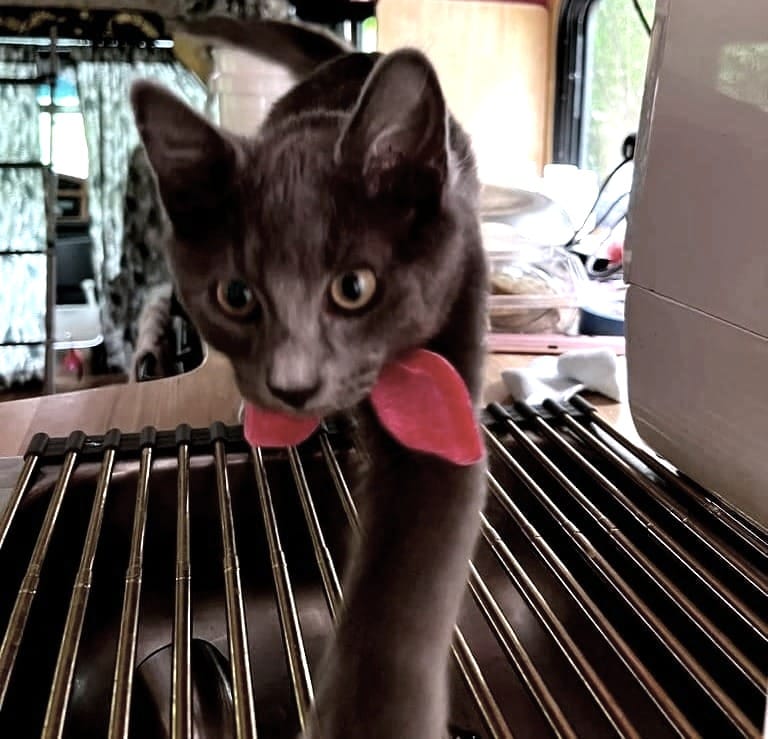
Can you? If you can, you’re less transphobic than I am. Because when I do this exercise, all I think is: No one can take that seriously. Even when I gave my cat a genderqueer collar, I thought: She looks absurd.
 Gabriel Mac
 Gabriel Mac
On his Netflix special, Private School Negro, W. Kamau Bell—a comedian who goes out of his way to respect, rather than denigrate, trans people—talks about how his daughter watches a children’s show where the doctors are Black women. She is, therefore, wholly skeptical when a cis white man shows up as her own doctor one day. I cannot begin to imagine how different I would feel had I grown up watching trans people in media be…anything. Or if I were watching them be the main character even now of more than a couple shows (like Canadian Broadcasting’s excellent Sort Of, on stupid fucking HBO. And obviously, I watched Pose). What would I think about trans people—about myself—if we were doctoring and lawyering our way across the dramas in my life?
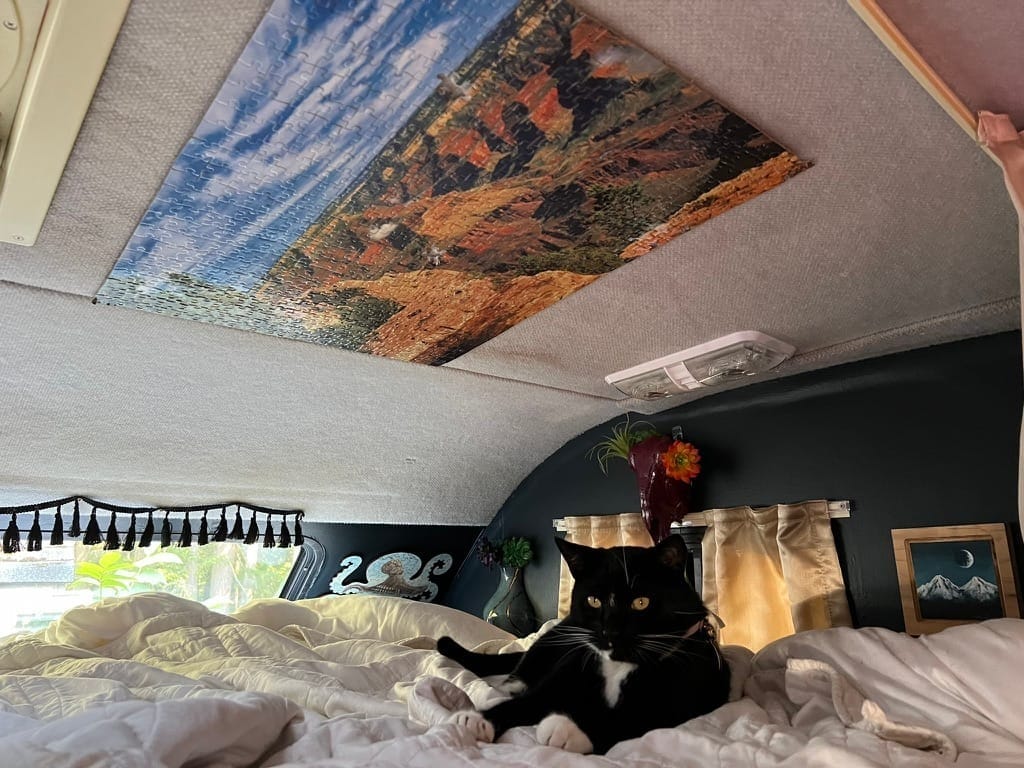
Yesterday, I started watching The Resident. I’ve lately been suffering a lot of flashbacks, the everbearing aftermath of cis white men who raped me without consequence in my childhood, even though I take a lot of medication that helps control my complex PTSD. My intuition asked that I work a puzzle while people played doctor in the background.
 Gabriel Mac
 Gabriel Mac
In the first two episodes of this show, the two straight cis white males who are its sympathetic heroes: literally kill a surgery patient because one won’t get examined for M.S.; ask a new intern, who’s brown, if he’s the product of affirmative action at Harvard; ask the same intern, while leering at physical therapy patients, if he’s into “Black? White? Brown?….Men?” One blackmails a Black female doctor with deportation to Africa unless she goes along with a risky medical procedure; this same dude soon diverts a heart transplant from a Black man to a rich white dude. I can’t even remember who eventually calls a woman, with the least flattering intentions, “Man hips.”
You guys. Six seasons later (I did not, for the record, watch them all), these two monsters are still the supposedly sexy leads of this show. When I try to picture a trans human at all, let alone one trans -“sounding” or -looking, in the roles of these men, rooted for, overpaid, and easily forgiven, I know for sure that we don’t belong there.
IMAGINE MY DELIGHT when I turned on the TV the other day, a day I couldn’t get out of bed, and saw a twist to my new game. Watching Peacock’s new The Good Daughter, I pictured a very obviously trans person in the role of other persons, like I do. Upon the introduction of one character, a secretary, I thought, Imagine if that was a trans person.
Then I thought: I can actually totally imagine if that was a trans person. And then, after looking closer: Oh. That IS a trans person.
The role is played by Harper Steele, of the much-lauded documentary Will & Harper (which I kind of hated, and critiqued, but realize looking through my drafts never published). It never becomes part of the storyline whether Steele is trans or not trans in her Good Daughter role, a basically unheard of situation for a trans actor. On 9-1-1: Lonestar, Brian Michael Smith plays a firefighter who’s trans—and passes so hard that a trans guy I dated complained that his trans character wasn’t played by a trans person. I watched all the Shameless episodes that Elliot Fletcher was in, appreciating that he played a gay trans guy—though he isn’t one. Jeremy Allen White’s character tells him, upon meeting, that he looks like a real dude. Both roles hinge on the actors transness being prominent but undistinguishable and surprising.
Thank god for them. I love so much—need so much—for trans people to be out in their characters. Watching Steele play a human without trans comment is like a further step into an equitable future I don’t even know how to believe in. But do you know why I found it so easy to picture a trans person in her role before I realized one was? Because she lives as a servant to the personal and professional lives of the other characters, without a whiff of a life of her own.
That’s not unusual for roles played by minorities, of course. Even the father of original fairy tales couldn’t imagine a pleasant ending for a protagonist as queer as himself. With all his wild imagination, even Andersen stuck the little mermaid, an outsider like him, forever in love with a boy, in a sea of longing and grief.
Hans Christian Andersen was bi. Let’s together un-erase one person’s queerness from our collective consciousness. Let’s psychically give him the burial deserves: In his own plot, surrounded by those of every friend and lover who did love him back, and made him feel like the center of his own story.